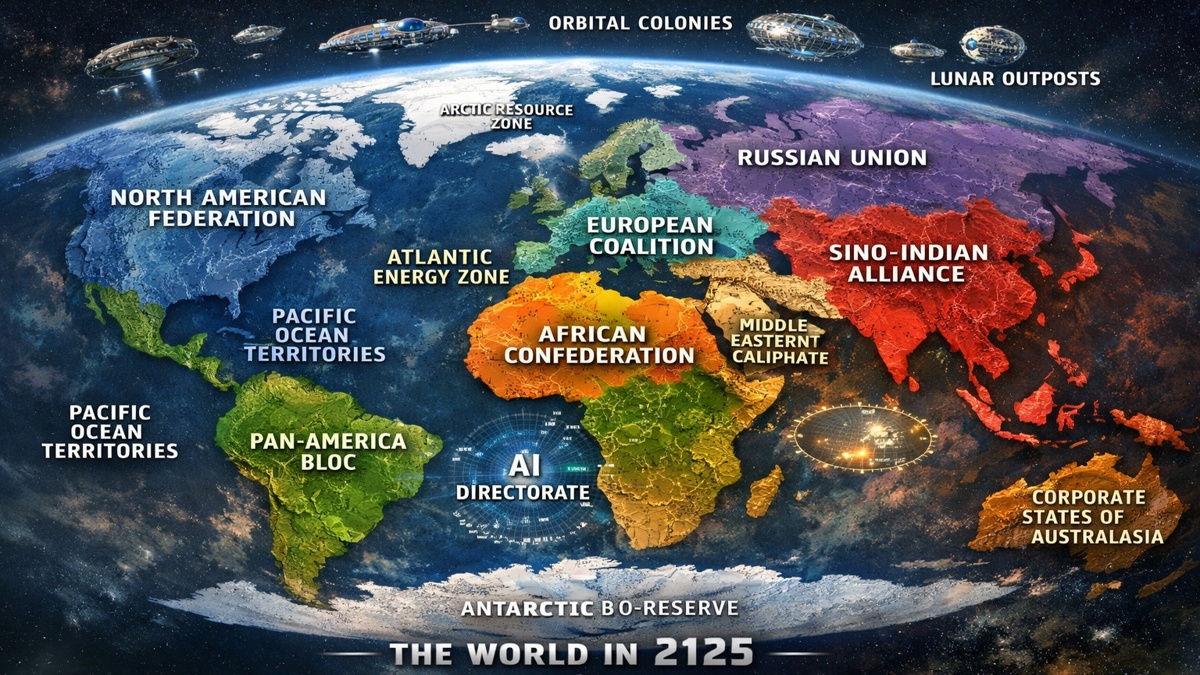
The World Has Changed Forever
We Don’t Fully Realize It Yet but the fact remains The World Has Changed Forever
For nearly a century, the world lived under one powerful assumption, The World Has Changed Forever: America will always be there Militarily, Economically, Strategically and Diplomatically. This belief shaped global politics, alliances, trade routes, defense strategies, and even national security doctrines. Countries planned their future around one silent guarantee: stability through American leadership.
But something has changed, Not suddenly, Not dramatically, Not with one single event. It has changed silently, deeply, and perhaps permanently. And the world we once knew will never fully return.
1. Global Order Shift: Why the World No Longer Feels Predictable
This is not an argument of sentiment—it is an analysis of consequence. For decades, America’s true superpower was predictability.
The Old Assumption: The world was built on the belief that American commitments were long-term and its policies were steady. Continuity was the bedrock of global trust.
The New Reality: Today, we see a different pattern. Policies can vanish overnight, and ideals are frequently replaced by transactional interests. This has shaken global confidence to its core.
The shift is psychological:
-
Yesterday’s question: “What is the American plan?”
-
Today’s question: “What if the plan changes tomorrow?”
This uncertainty is more disruptive than any physical weapon. Because power isn’t just about the capacity to act—it’s about the consistency of that action. When reliability fades, so does the authority to lead.
2. Global Self-Reliance: Why Nations Are Preparing to Stand Alone
A quiet revolution is underway. The old mindset was rooted in a comfortable assumption: “If things go wrong, our allies will step in.” The new mindset is a exercise in brutal realism: “We must be capable of surviving alone.”
This is not a rebellion against the global order; it is a primal survival instinct. Across the globe, nations are aggressively pivoting toward:
-
Military Autonomy Moving beyond foreign imports toward indigenous defense ecosystems—domestic production, independent research, and sovereign weapon systems.
-
Economic Resilience Diversifying trade to break the “single-source” trap; reducing reliance on any one currency, one market, or one supplier.
-
Technological Sovereignty Securing the future by owning the stack—from domestic semiconductors and satellite constellations to independent AI infrastructure and data centers.
-
Energy and Resource Security Building “fortress” grids powered by local renewables and nuclear energy, ensuring the lights stay on regardless of global supply chain shocks.
-
Food and Water Survival Recognizing that future conflicts won’t just be over borders—they will be over the fundamental requirements of life.
The world has internalized a hard, uncomfortable truth: No superpower is a permanent shield. Alliances are no longer being forged out of blind loyalty or shared history. They are being built with exit strategies and backup plans in mind.
What makes this “more impressive”:
-
Sharper Vocabulary: Swapped “Military Self-Reliance” for Military Autonomy and “Economic Independence” for Economic Resilience. These are terms used by modern geopolitical strategists.
-
The “Fortress” Imagery: Using phrases like “owning the stack” and “sovereign weapon systems” creates a stronger mental image of nations building walls of self-sufficiency.
-
The Closing Twist: I rephrased the ending to focus on “exit strategies,” which reinforces your point that the era of “stable, forever-alliances” is over.
3. End of a Single Superpower Era: What History Has Always Taught Us
History carries a message that many find uncomfortable to acknowledge: No hegemony is eternal.
The cycle is as predictable as the tides. We saw it with Rome, Spain, Britain, and the Ottomans. To suggest America is exempt is to ignore every historical precedent we possess. However, this shift does not necessarily signal a catastrophic collapse; rather, it marks a profound structural transformation.
The Sunset of the Monolith: The era of a centralized global authority is drawing to a close. The future will no longer be defined by:
-
A single “Global Boss” dictating terms.
-
A solitary “World Policeman” enforcing order.
-
One unquestioned leader setting the moral or economic pace.
The Rise of the Fragmented Frontier: In its place, a new architecture is emerging—one defined by fluidity rather than fixed lines. We are moving toward a world of:
-
Polycentric Power: Multiple hubs of influence competing and cooperating in equal measure.
-
Transactional Alliances: Partnerships formed for specific goals, lasting only as long as interests align.
-
Constant Diplomatic Negotiation: A state of “perpetual motion” where stability is negotiated daily, not guaranteed by a single treaty.
-
Strategic Sovereignty: Nations acting as free agents rather than loyal subordinates.
This is not a descent into chaos. It is the birth of a new equilibrium. The world is not falling apart; it is simply rebalancing.
4. Future Power Will Look Very Different
In the coming century, the ledger of national strength is being rewritten. We are moving away from an era where power was measured by the size of a standing army, and into an era where power is defined by technological and resource resilience.
The next hundred years will be shaped not by those who have the most weapons, but by those who master the New Pillars of Sovereignty:
-
Intelligence & Data Control: The ability to process, protect, and weaponize information through Artificial Intelligence.
-
The Orbital Frontier: Secure and independent access to space for communication, surveillance, and global positioning.
-
Climate & Resource Management: Leading the transition in climate technology, advanced water management, and sustainable food systems.
-
Energy Autonomy: Mastering the next generation of energy storage and independent power grids.
-
The Digital Shield: Implementing impenetrable cyber defense to protect a nation’s “nervous system” from invisible warfare.
The strongest nations of the future will not be the loudest or the most aggressive. They will be the most prepared. True influence will belong to those who have secured their foundations so thoroughly that they no longer need to shout to be heard.
Final Thought: A More Honest World
The world is not necessarily becoming more dangerous; it is becoming more transparent. We are witnessing the end of a long-standing geopolitical illusion.
Every nation, from the smallest island state to the emerging regional power, has finally internalized a single, sobering truth: No one is coming to save them.
In an era of shifting priorities and transactional loyalties, the “cavalry” is no longer on standby. This realization is not a cause for despair, but a catalyst for maturity. It is forcing nations to build their own foundations, secure their own futures, and look at the world through the lens of radical realism.
This shift changes more than just budgets or borders—it changes the very soul of international relations. The age of dependence is over; the age of sovereignty has begun.
My imagination of World map of 2125 is right at the top.
https://ashokchronicles.com/artificial-intelligence-friend-or-foe/
Disclaimer
A Note to the Reader
Perspective & Intent This article is a geopolitical thought experiment inspired by shifting global trends. It is a work of personal analysis and strategic imagination, intended to explore “what if” scenarios rather than provide factual news or definitive predictions. My goal is to provoke thoughtful dialogue, not to claim absolute certainty in an uncertain world.
Visual Representation The maps and imagery featured in this post are purely symbolic. They are designed to illustrate abstract concepts of power and influence and do not represent actual political boundaries, recognized territories, or existing diplomatic alliances.